

How to choose an AI consulting partner: a buyer's checklist
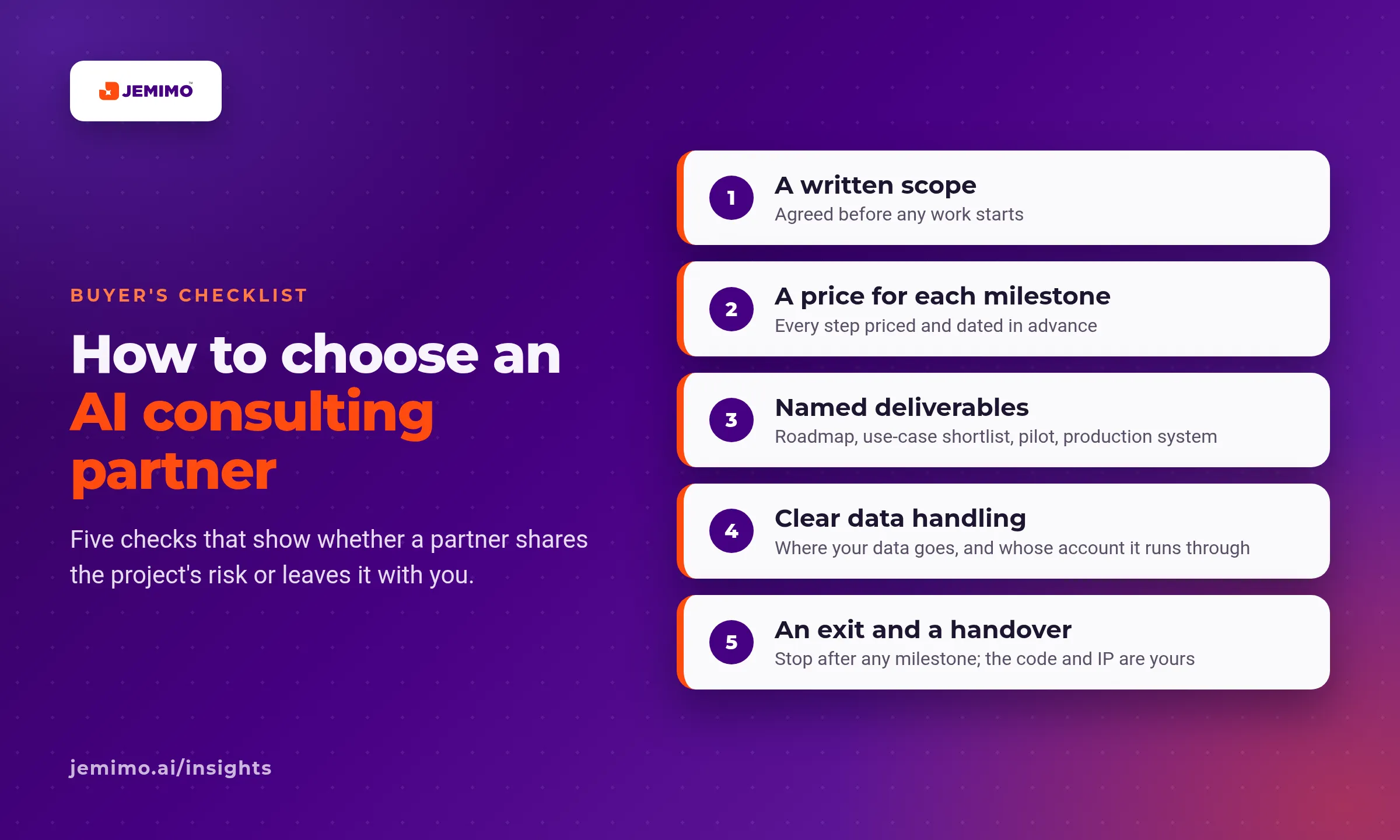
Five checks for choosing an AI consulting partner: a written scope, milestone pricing, named deliverables, clear data handling, and an exit with handover.
Harish Raghunathan · Founder, Jemimo AI
Choose an AI consulting partner that agrees the scope in writing before work starts, prices each milestone separately, names the deliverables of every step, explains where your data goes, and lets you stop after any milestone with what you have paid for. Those five checks show whether a partner shares the project's risk or leaves it with you.
AI projects carry more uncertainty than most technology work. Nobody knows for certain, before trying, whether a use case will pay off. A good partner does not pretend otherwise. Instead, they structure the work so that the uncertainty is resolved in small, priced steps, each of which leaves you with something you can use.
The five checks
- A scope agreed in writing before work starts. The scope should say what the work covers, what it does not, and what "done" means. If a partner cannot write it down after a scoping conversation, the problem is not yet understood well enough to price.
- A price for each milestone. Open-ended hourly billing moves all of the risk to you. Milestone pricing means you know the cost of each step before it starts, and you decide whether to take the next one.
- Named deliverables for every step. Strategy work should produce a roadmap, a use-case shortlist and a cost/benefit estimate. A pilot should produce a working system on one use case. A production build should end with a system your team runs. Activities, such as workshops or discovery sessions, are not deliverables.
- A clear answer on data handling. Ask where your data is processed, whose AI provider account it runs through, who can see it, and what happens to it when the work ends. Vague answers here are a reason to stop.
- An exit and a handover. You should be able to stop after any milestone and keep what it delivered. Agree up front that the code and intellectual property built for you are yours on handover, with documentation your team can use.
Two more questions worth asking
Who will do the work? Ask whether the people on the first call are the people who will build, and ask for their names in the scope.
How will the pilot be judged? Agree before the pilot starts what success looks like, in measures your business already tracks. A pilot without a success test tends to become a demo that never reaches production.
Warning signs
- A proposal that lists activities and hours but no deliverables.
- No milestone that ends in something usable on its own.
- No written answer on where your data goes.
- No way to stop without losing the work done so far.
- Ownership of the code left unstated until the contract stage.
How we answer these questions
At Jemimo AI, every project starts with free scoping, which takes about a week and ends in a written scope with every milestone priced and dated. Each milestone names its deliverables, and you can stop after any of them and keep what it delivered. We can build on your own AI provider account and key, so your data stays in your account. The code and intellectual property we build for you are yours on handover. We take on two engagements at a time, so the people who scope the work are the people who build it.
See how our AI consulting engagements run, or, if your work is already well defined, read about fixed-scope AI engagements.
Frequently asked questions
- What should I look for in an AI consulting partner?
- Five things: a scope agreed in writing before work starts, a price for each milestone, named deliverables for every step, a clear answer on where your data goes, and the right to stop after any milestone and keep what it delivered.
- How should AI consulting be priced?
- Per milestone, with each milestone priced and dated before it starts, so you know the cost of every step in advance. Small, well-defined pieces of work can also be bought as fixed-price packages.
- What should an AI strategy engagement deliver?
- A roadmap, a shortlist of use cases worth pursuing and a cost/benefit estimate for them. If a proposal lists workshops and interviews but no documents you keep, ask what you will hold at the end.
- How do we protect our data when working with an AI consultant?
- Ask where your data is processed, whose AI provider account it runs through and what happens to it when the work ends. A partner who can build on your own provider account and key keeps your data in your account rather than theirs.
- Who should own the code an AI consultant builds?
- You should, and it should be agreed in writing before work starts. A partner's own products can reasonably stay theirs, but the code and intellectual property built for you should transfer to you on handover.
- Can we stop an AI project partway through?
- With milestone pricing, yes. Each milestone should end in something usable on its own, such as a roadmap or a working pilot, so stopping after it still leaves you with what you paid for.